

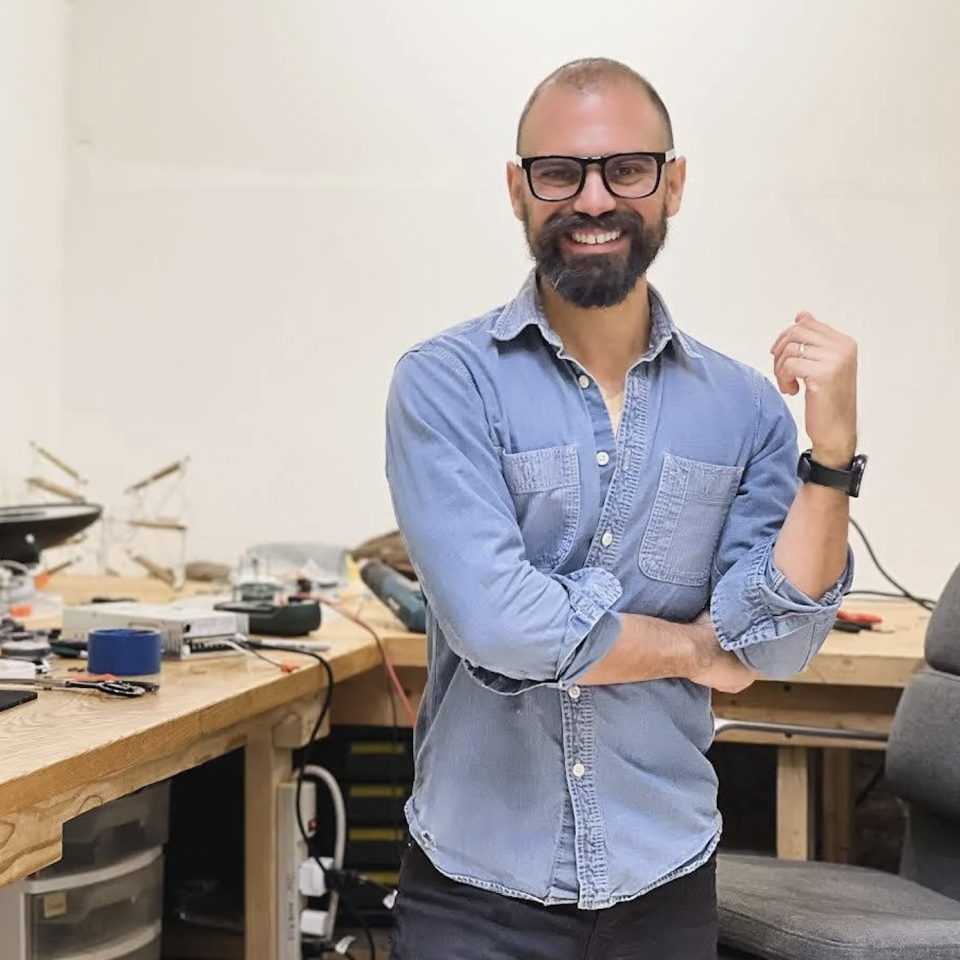
Member Spotlight: Joseph Morris
Art Member Spotlight NewsElsa Lamere
Who are you and where are you currently located?
Joe Morris
Hi, I’m Joe, Joseph Morris, and I'm in Brooklyn. I am an artist, educator, and professor of 3D design and sculpture at SUNY Westchester Community College, where I teach foundation year students, and I am also the director of the WCC Art Gallery. I create sculptures and installations, and work with electronics, sound, light, and motion, as well as public space.
Elsa Lamere
How did you end up at SUNY Westchester Community College?
Joe Morris
I started teaching there in 2020 during the pandemic. Before that, I was working within the industrial design program and was teaching at Pratt Institute. I managed the 3D printer labs, fab studios, CNCs, and lasers, while also teaching
classes on electronics and prototyping. When I was given the opportunity at Westchester for a full-time position in 3D design and sculpture, it spoke to me.
I love teaching foundation students. I love getting to know my students and pushing that initial spark of creativity when they're just getting started. They often know that there's something that they're interested in, but they're not sure what they can do with it or where it can lead, and I enjoy helping those students to be more confident, expressive, artistic, and able to communicate their ideas through making things.
After they complete their two years at WCC, we send them off to four-year universities, like FIT, SUNY Purchase, and Pratt. It's a transfer degree, so it's especially nice for people who wouldn't necessarily have access to a four-year university for the first two years.
Elsa Lamere
Your piece, Babel in Reverse, which is on display with the New Media Caucus exhibition The Art of Disappearing, was also in person at Pratt Institute, correct?
Joe Morris
It was, I think about two years ago, so it would have been around December/January 2024. It was a cool installation, and where the documentation shown in The Art of Disappearing was taken. Babel in Reverse is an iteration of a larger piece with the same title, which was installed in the anchorage of the Manhattan Bridge. There is a huge archway that's about 150 to 200 feet high and 150 feet long. The piece that Abigail curated for The Art of Disappearing had about 40 speakers lined up in a gallery horizontally, but the original piece had almost 200 speakers, and it spanned the whole archway. Each one had a single voice of a person speaking either an endangered language or a familiar language spoken in New York. Each voice would be activated algorithmically, which would lead people through the space. So, when I was invited by Helio Takai to bring the piece to Pratt, and to a smaller space, the piece had to evolve. I am glad it did because the space at Pratt, while maybe 25 square feet, was a very immersive space. It had an amazing projector that could project onto all the walls, the ceiling, and the floor, which was something the piece originally didn't have. So, I cut the speakers down to 40 from 200, lined them up horizontally, and rejiggered some of the software so that the voices of each endangered language would still be heard through the space. Every time a voice was activated on one of the speakers, a sound wave was created, but visually shown with translated water, like waves and ripples, and the rhythmical motion of water. It was really fun because it turned a small space really immersive. Having that sort of rhythmic sound and light wave animation happening in conjunction with the people speaking their endangered languages, I found, can really slow the viewer down.
Elsa Lamere
That's so awesome. So, obviously, this virtual exhibition, The Art of Disappearing, is very different from the in-person exhibition. What does being a part of it mean to you?
Joe Morris
I'm very happy to participate in this virtual exhibition, it’s great. I envy my friends who are video artists, because they can send off their media and not have to set it up in the same way. So, I was very excited about the thought of being in a virtual exhibition because they could set up my work overnight and show it.
It's interesting to read Abigail's curatorial statement and her recognition of the loss of multiculturalism. Babel in Reverse is a representation of the coming together of people and the recognition of the languages spoken and people that live in New York City. It represents the diversity of our city and as a place where people gather.
Elsa Lamere
I agree. I am also curious to hear more about which languages you chose and the ‘why’ behind each one.
Joe Morris
I worked with the Endangered Language Alliance, and they allowed me, along with my collaborator at the time, Owen Trueblood, to use some of their audio. They're the ones documenting the endangered languages in New York and have created this amazing language map of New York City. The person we were in communication with is Ross Perlin, who is the co-director of the ELA, the Endangered Language Alliance. Every dot on the map represents a place where people have been documented speaking a language currently or historically. There is not an audio for every one, but some of them have audio. There’s also a spreadsheet you can look at to see some of the data. It's really fun to pick apart the data and see where the languages are. Some languages are represented more than others just because of the way the audio is shared, but we try to get as broad a perspective as possible with what is available. I totally want to direct people to this amazing resource.
Elsa Lamere
I'm totally going to check that out after this too. Thank you for sharing. And do you have any other current projects that you're working on that you'd like to share?
Joe Morris
Yeah, so I'm working on a bunch of stuff. Babel in Reverse was a huge project, and I'm in a new studio, so I’m restarting some of my practice again. I've been creating new work that focuses on the relationship between technology and natural systems. So, I have a few pieces I can talk about.
I've been putting together both 2D and 3D LED matrices that are simulations of water ripples, similarly to the background from Babel in Reverse at Pratt, and some of them are sound-activated. I created one for Gowanus Arts when they had their annual Tower Show, which is a really fun exhibition. They had around 300 artists make work based on a tower design that they shared. I threw a bunch of LEDs behind this water tower silhouette and I connected it to the New York Harbor data feed. So inside the tower was a display of a dynamic sloshing of water, which is affected by the height of the tides. So as the tide comes in, the tower fills up, as it goes out, it lowers, and when it rains, that water gets more turbulent and changes color. I also have a water simulation I've been working on with a 3D LED matrix.
I have another piece I’ve been calling a Solar Portal. There are a bunch of NASA satellites out there that look at the sun, and every 5 minutes, it snaps a frame, and it updates. So, what we see in Solar Portal is about a 90-second time-lapse clip of the past 48 hours, and it is as close to a real-time viewer of the sun you can get on a small device.
I also have this rotary phone that I call Landline, which has a Raspberry Pi inside of it. It connects to the US Geological Survey site, and every time there's an earthquake, it rings in an order of magnitude. For example, if it's a 3.5, it'll ring three times. It's so loud, and it catches me off guard all the time. It's amazing. It connects you to these things that are happening that you don't know or normally think about, like the fact that the earth is constantly moving and changing. It rings about every 5 minutes when it's plugged in. Most of the earthquakes are small and will only ring once or twice. But if you pick it up, you can hear a voice describing the earthquake, where it was, how strong it was, and whether it was a minor or major earthquake. Living in New York City, the connection to an outdoor wilderness doesn’t exist in the same way it does in other places, so Landline provides a really cool way to connect to nature through technology.
So that's what I've been working on lately. Lots of these smaller projects compared to a project like Babel in Reverse, which was at the scale of architecture. I'm just getting back into my studio after moving studios; my previous space burned down in the fall. There were about 200 artists who were displaced. So I'm just getting set up, and I'm trying to make work quickly, and that doesn't have the timeline a large architectural project does.
Elsa Lamere
I am so sorry to hear about that, did you lose a lot of work from fire? That's horrible.
Joe Morris
It was horrible. Yeah, I lost about half my stuff, which was fortunate because there were people who lost everything. The fire didn't touch my studio, but the sprinklers did, and there were two days of intense water hosing. So when we got in, after about two or three weeks, everything had grown mold and was smoke-damaged. I had to throw out a lot of stuff, and I'd been there for 13 years, which is why I’ve been making these smaller pieces to kind of restart my practice in a new and different way.
Elsa Lamere
Yeah, absolutely. And where can people see your work physically and digitally?
Joe Morris
If anyone’s in Brooklyn, I would love to do a studio visit. Just reach out to me. And then online, there's my website, emotivemachine.net. And my Instagram is @emotivemachine.
Links to works:
Babel in Reverse, Global Voices at Pratt Insitute
Anchorage | Babel in Reverse
3D LED Matrix
Landline
Solar Portal
Ripple Surface