
Member Spotlight: Nimrod Astarhan
News Member SpotlightElsa Lamere
Who are you and where are you currently located?
Nimrod Astarhan
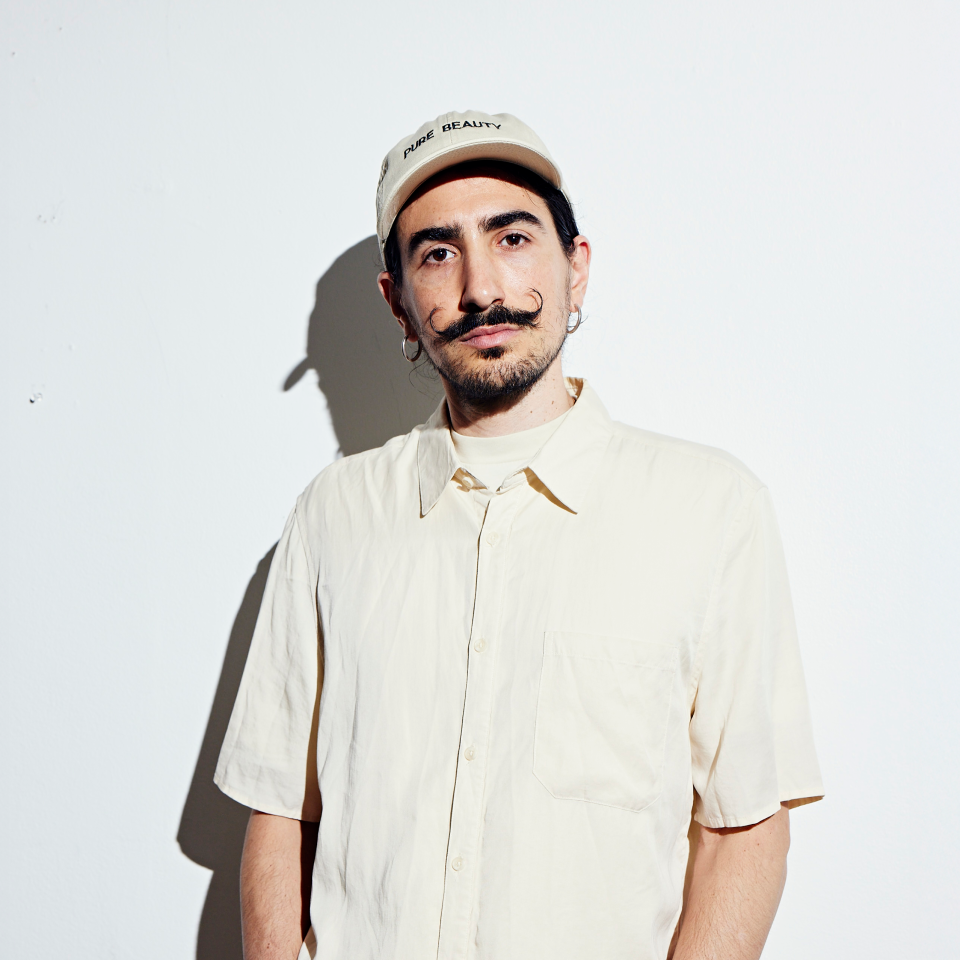
I am Nimrod Astrahan. I also go by Nemo. I am an artist, technologist, and scholar, and I'm currently based in Berlin.
Elsa Lamere
What brought you to Berlin, and was there a reason you were drawn there?
Nimrod Astarhan
I came to Berlin for a residency and then got a second with Künstlerhaus Bethanien. After I got settled, I decided to stay for the time being. Before that, I was teaching at the School of the Art Institute of Chicago, and at the China Academy of Art and other institutions. In the past year, I was able to take some time off and focus on my work, which has been very informative and a privilege. I am very grateful for the support that I received, which allowed me to do this.
Elsa Lamere
The piece of yours, Khazar Archaeological Confabulations, is currently a part of the New Media Caucus exhibition, The Art of Disappearing. Would you be able to tell us more about this piece?
Nimrod Astarhan
This body of work is engaging with the Khazars, or the Khazar people, which was a multi-confessional kingdom that embodied and symbolized many liberatory aspects that are of interest to me. It was a very flourishing and harmonious society, and it is a very rare example of a society that was multi-ethnic and multi-religious. They existed between the eighth and the eleventh centuries, so it was exceptional to have a society that was so heterogeneous. And at the same time, it also exhibited some non-hierarchical political structures. I'm also interested in some of their cultural practices that engaged with the idea of energy. They were Tengrists, meaning they believed in the Sky God and the eternal blue sky
Very recently, an archaeological dig began in a city called Astrakhan, which is also my last name, in southern Russia. An archaeologist from the University of Astrakhan uncovered what they think is the lost Khazar capital, which has been a lost city like Atlantis or Pompeii. They have been digging and uploading findings online in real-time, even before carbon dating and contextualization. They're
associated with the team that is doing the archaeological dig, but it is not yet explicitly associated with the Khazar. At this point, we don’t know when these things are from or what they were used for. Still, for this project, I was able to 3D model some of these archaeological findings, and I created a synthetic object database that was used to train a custom-built AI model. This AI model is a StyleGAN, so it was trained from scratch on my computer. As a technologist, I engage with technology in this way so I can fiddle and have control over it. The database I built was of archaeological drawing-style images of the objects. The network they built became black and white, which was unintended, so I had to change a bit of the code and the training process to patch the algorithm’s material to use it as an artistic medium.
The resulting cyanotypes look kind of like cells and abstract confabulations. I think about them like future artifacts that embody some of the values the Khazars had— this kind of multiplicity and flourishing across values.
Elsa Lamere
Did the materials you chose have any specific significance or meaning, like the cyanotype in particular?
Nimrod Astarhan
Yeah, so a major part of the process was, of course, engaged with digital media, but the materialization of the images produced were then turned into cyanotypes. This reflects the Khazar Tengrist myths on how they believed in the titular Sky God and the eternal blue sky. I’m connecting and interacting with the same sky and light they were in order to render these kinds of future causal artifacts.
Elsa Lamere
What does being a part of this specific exhibition in the New Media Caucus mean to you?
Nimrod Astarhan
I really appreciate the different ways digital technology can be used to amplify sidestep narratives and refigure them. I appreciate the framing of creating a cultural discourse, creating a physical encounter, whether it is virtual or actual, with some of these sidestepped narratives and forgotten histories. I think with The Art of Disappearing, the curator, Abigail Prakarsa, did a great job of bringing artists who are dealing with such themes into dialogue in this virtual space. We didn't need to ship our installations across the ocean and meet somewhere. Instead, we created this place online where people can experience our works together, which come from very different perspectives and backgrounds. I think that even though this particular work has a lot of weight in the way it is materialized and the choices that were made, I think it's nice to have an opportunity to also pay tribute to a lot of the digital parts of the process, and present it in a way that can showcase that.
Elsa Lamere
And do you have any other current projects that you would like to share?
Nimrod Astarhan
In the past year or so, ever since coming to Berlin, I have been working a lot with artist-made solar panels, sensing circuits, and e-ink displays, which are built from copper and saltwater. Through chemical electromechanical principles, they produce a little bit of electricity that can be sensed, and I think of them as these probes into the energy domain, which I'm very interested in. I've been doing that alongside the research into the affordances of energy that go beyond thermodynamics.
Some works are also related to the Khazars, as they also had this very particular relationship to energy. I traced things like electromagnetic memory effects, and by using a handmade solar panel in the same shape as a Khazar sun pendant, the artwork interacts with the same energy the Khazars once interacted with.
Elsa Lamere
Where can people find your work, physically and digitally?
Nimrod Astarhan
Beyond The Art of Disappearing, I have work up online as a part of the Future of Writing Art Gallery:
Future of Writing 2026 Art Gallery
And I have a recent publication called Antennology: Cosmos to Canvas that is available via open access from Leonardo (MIT Press):
I have work up in Chicago, which is a part of the current iteration of a residency that I did called BADS Lab:
Back…