

Symposium Spotlight: Anshul Roy
News Member SpotlightInterviewed on February 19, 2026.
Who are you and where are you located?
I am a visual artist from India who is currently based in Boulder, Colorado
When did you first start working with time based/ Interactive Media?
Having just started in 2023, I am a beginner in New Media art, and my prior background was in Photography. As a 21st-century photographer, I had to grapple with the fact that most images in our contemporary society exist as computational objects on digital screens. There came a point in my life where working with photography meant that I spent most of my time on a laptop. I eventually realized that the Web Browser could itself be an artistic canvas, and that the Internet holds within it an abundance of interesting material that I could appropriate. Since this realization, my art practice has completely transformed, and I am trying to respond to this new reality of our Networked Image culture.
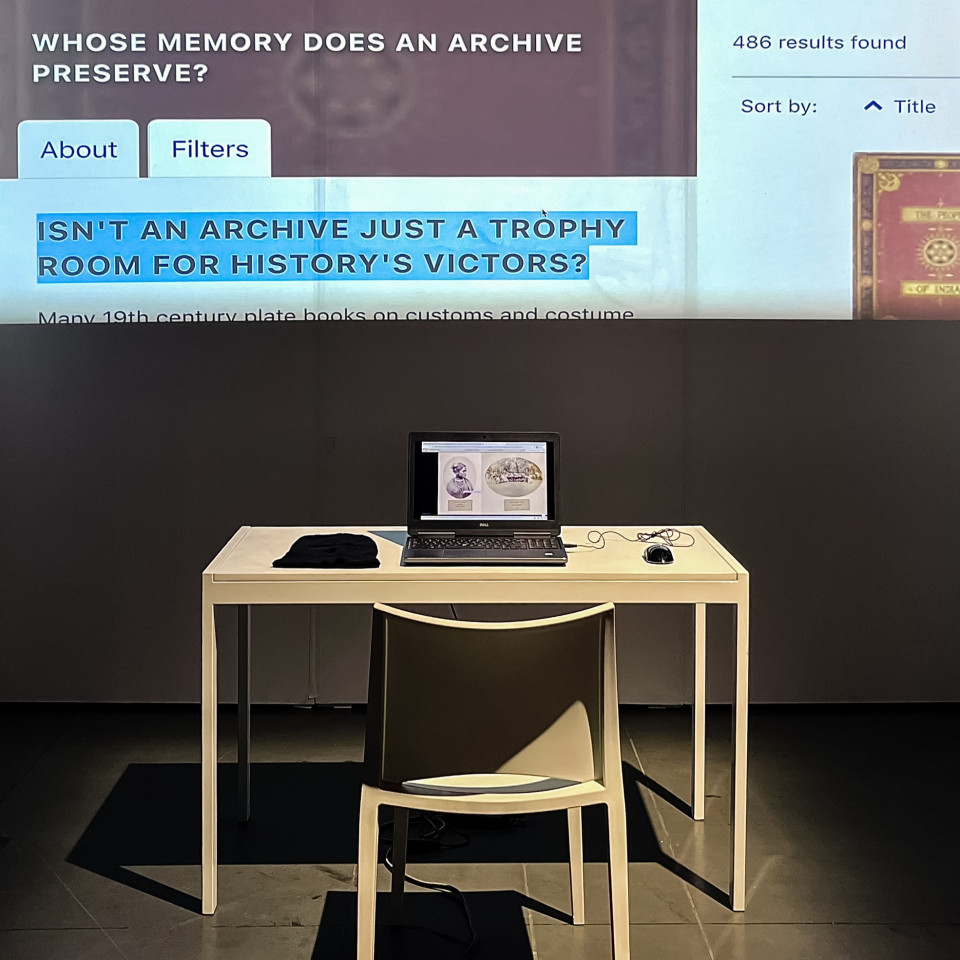
The bedrock of my current work is the notion of contemporary photographs as HTML tags. I am particularly interested in exploring how dehumanizing ethnographic images, once bound by their physical and historical contexts, now float around in cyberspace stripped of their gravitas, taking on new lives and meanings. I was fortunate enough to exhibit my browser-based project "Rage Against the Archive" at ACM SIGGRAPH in 2024. Winning the "Best in Show" award at SIGGRAPH has motivated me to continue exploring New Media art and learn more.
What inspires your work?
My artistic practice is inspired by Postcolonial discourses, exploring issues like identity, historical memory, cultural representation, and visual ethics. I am particularly interested in critically probing how British colonizers employed photography in India for “othering” and visual propaganda, and how these ethnographic photos exist in contemporary institutional archives. Through appropriation techniques and digital media, I recontextualize such historical photographs to question and challenge their enduring impact on our society.
Tell us a little more about your work for the symposium?
During the New Media Caucus Symposium, I would be teaching a workshop titled "Critical Fabulation, Digital Archives and Infrastructure Infiltration." This hands-on workshop invites participants to critically and creatively engage with digital archives through the lens of Critical Fabulation. Drawing on thinkers such as Saidiya Hartman, Allan Sekula, and Jacques Derrida, participants will examine the archive as a fragmentary, incomplete, and inherently political entity. They will be encouraged to “activate the archives” through imaginative strategies that challenge institutional authority and surface silenced narratives. Participants will learn basic HTML and use the browser tool “Inspect Element” to locally modify digital archives of their choice, screen-record, and share their critical interventions. This workshop combines a Lecture-Performance, group discussions, and creative experimentation, foregrounding both ethical reflection and technical engagement with archives.
Do you have any current projects that you're working on that you would like to share?
What does it mean to ethically look at someone’s pain? How should we all, as a more conscientious society, consume images of historical atrocities online? How can we creatively engage with institutional archives to question their contents?
"Deserving Objects of Gratuitous Relief" is a research-based art project that aims to interrogate these questions through the lens of colonial photography in India. In this project, I aim to critically examine an album found on the Getty Museum’s website consisting of photos taken by the British military photographer Willoughby Wallace Hooper during the 1876-78 Madras Famine. This famine was a devastating consequence of British colonial rule, which led to the deaths of around 10 million people. The British government’s minimal relief efforts were part of a broader political and ideological project, in which the suffering caused by this famine was photographed and circulated as propaganda to justify imperial rule under the guise of “The White Man’s Burden.” These images and their carefully crafted captions played a crucial role in shaping the narrative of British superiority and the supposed helplessness of the Indian populace. Despite their promise of bringing British viewers closer to witnessing the suffering of Indians in a compassionate manner, these photos instead further emphasised the distance between the viewer and the famine victims, “othering” the subjects in this process.
During this workshop, I would be using the photos from this album as a case study about visual ethics and discuss their online circulation. In his seminal essay "The Work of Art in the Age of Mechanical Reproduction," Walter Benjamin expressed his concern about an original work of art losing its aura when it is mechanically reproduced. I feel that this issue has been completely amplified in the age of digital reproduction, and hence it is important to think about “digital identity” and how we all could be more ethical consumers of online data.
What brought you to the New Media Caucus?
Presenting my work at the New Media Caucus symposium is crucial to my research and professional development. While my work is grounded in postcolonial critique, this symposium places it in dialogue with artists and scholars working in Digital Arts. This would allow me to test my research in an interdisciplinary setting and to receive feedback from a diverse audience.
Where can we follow your work?
https://anshulroy.com/